
Service area

Roofing in Phoenix.

A roof hidden behind a parapet can conceal ponding and worn details. Phoenix roofing decisions should connect drainage, existing layers and rooftop cooling equipment with the choice of tile, shingle or SPF.

The roofing decision

Look behind the parapet before choosing a coating.

A street view tells little about a Phoenix low-slope roof. Before comparing prices, establish the surface material, how water reaches the scuppers and what earlier work changed around cooling equipment. A later tile subdivision needs a different inspection, with attention to the underlayment and the roof-to-wall details beneath the tiles.

Discuss your Phoenix roof
  1. Treat drainage and coating as separate decisions

    Inspect low spots, scuppers, parapet caps and roof-to-wall transitions before specifying a new surface. A recoat needs a suitable substrate and defined preparation. If the proposal includes drainage correction, ask exactly which detail changes and how the revised route will work.

    Explore spf recoating
  2. Investigate the history around rooftop cooling

    On a postwar home, active or removed cooling equipment can leave curbs and patched openings in an older roof. Identify those locations and inspect the accessible decking and flashings. Include equipment coordination and abandoned-opening treatment in the replacement scope.

    Explore roof replacement
  3. Inspect tile where water changes direction

    For a tile-roofed subdivision home, ask for findings at valleys, walls and penetrations. Compare the affected underlayment with surrounding areas before deciding whether localized work is practical. Sound-looking tiles alone do not establish a watertight assembly.

    Explore tile roofing
Illustrative view over postwar homes with flat roofs behind parapets and low shingle roofs, fan palms and mesquite, Camelback Mountain beyond
Phoenix, illustrated. Not a photograph of our work.

Conditions

Roof exposure in Phoenix.

  • A heat season measured in months

    Phoenix averages 111 days a year at or above 100 °F. In 2024 it recorded 113 consecutive days at 100 °F or more, from May 27 to September 16, and a record 70 days at 110 °F or above. The all-time high is 122 °F, from June 1990. That heat and UV thin coatings, harden sealants and work flashings loose, so the wear points matter as much as the open roof.

  • Monsoon, June 15 to September 30

    The National Weather Service has set Phoenix’s monsoon season as June 15 to September 30 since 2008. Annual rain is about 7.22 inches on the 1991–2020 normals, and a third to half of it can fall in that season as short, heavy storms. On a flat roof behind a parapet the water has to reach a scupper or drain quickly. Ponding, blocked scuppers and stains at the base of the parapet are worth checking before July.

  • Dust walls ahead of the storms

    Monsoon thunderstorms can push a wall of dust ahead of the rain. On August 25, 2025, a haboob followed by wind and rain crossed metro Phoenix; the Associated Press reported a damaged terminal roof at Sky Harbor and more than 15,000 customers without power. Dust collects in valleys, gutters and roof drains, and the gusts load roof edges and loose tile. Check drains and edge metal after the season, not only after a leak.

  • Wind design is looked up per address

    Maricopa County publishes no special wind region list of the kind Riverside County does. The design wind speed for a Phoenix property comes from the ASCE 7 maps that the adopted building code references, looked up for that site. It decides fastening schedules, tile attachment and edge metal, so establish it for the actual address rather than reusing a figure from another project.

The roofs here

The roof assemblies behind Phoenix’s buildings.

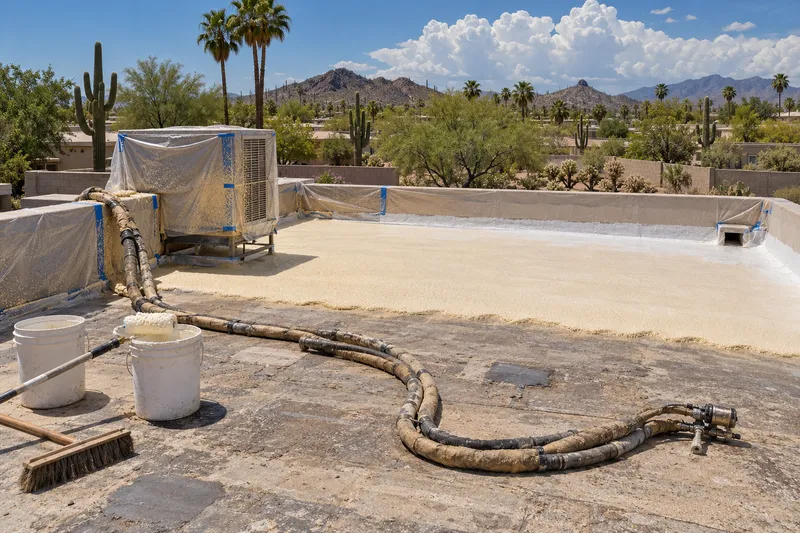
Illustrative flat roof behind a parapet partway through a spray foam re-roof, fresh foam beside the old surface, a masked evaporative cooler, spray hoses and buckets of coating
Illustration of the roofs described here, not a job of ours.

Flat roofs behind parapets

Many Phoenix houses and small commercial buildings have low-slope roofs hidden behind parapet walls, finished in spray foam, built-up or rolled roofing, or a coating over an older layer. From the street the roof cannot be seen, which is how ponding and cracked coatings go unnoticed for years. An inspection starts at the scuppers, the parapet caps and the seams where the roof turns up the wall.
Houses from the air-conditioning boom

Air conditioning made Phoenix’s postwar boom possible: more was built in 1959 alone than in the years from 1914 to 1946. Houses from that period may have been re-roofed several times, and some still carry roof-mounted cooling equipment. Establish how many layers are on the deck, what condition the deck is in and how the equipment curbs were flashed before pricing a new surface.

Concrete tile on later subdivisions

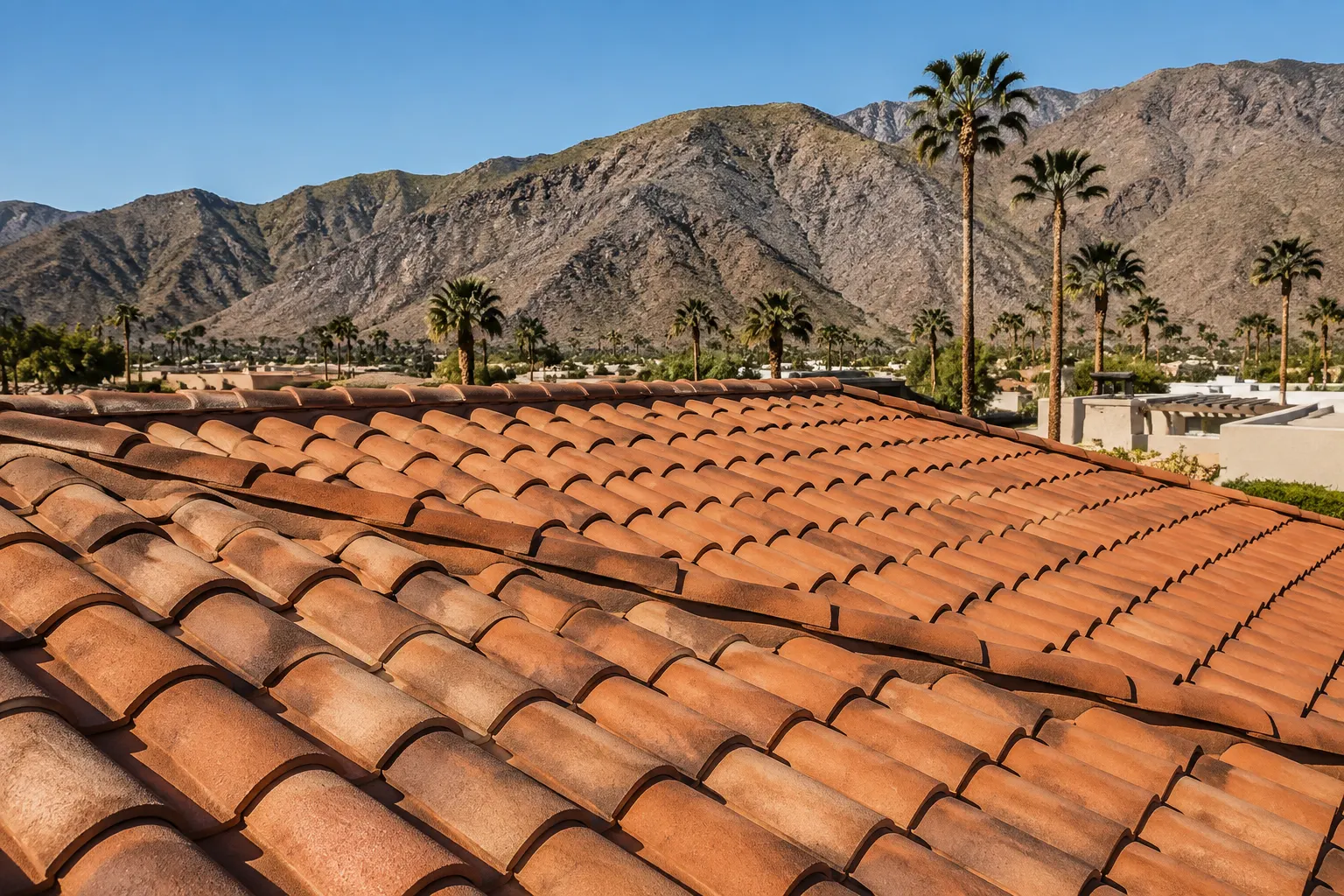
Concrete tile covers many of the subdivisions built after the postwar years. The tile and underlayment need separate assessment, with attention to valleys, walls and penetrations. A tile roof that looks intact from the yard can still be letting water through. Lifting tiles at those points shows what the open field of the roof cannot.

Local building patterns help guide an inspection. Your roof’s actual condition, materials and repair history determine the recommendation.

Compare the same work

Before you approve a Phoenix roofing estimate.

Use these points to make the proposed work specific to your property.

  • List active and abandoned cooling-equipment openings and the party coordinating equipment work.
  • Describe substrate assessment, coating compatibility and preparation rather than coating color alone.
  • Record the scuppers, low spots and parapet details included in the price.

Check the local approval route

Ask City of Phoenix Planning & Development Department which requirements apply to the parcel and proposed work. If another authority or an association also reviews the project, establish that before ordering materials.

City of Phoenix Planning & Development Department

Code and permits

Roofing codes and permits in Phoenix.

Confirm the requirements for the building and proposed roof assembly. The links below go directly to the relevant authorities.

The 2024 Phoenix code

Phoenix City Council approved the 2024 Phoenix Building Construction Code on June 18, 2025, with an effective date of August 1, 2025. It adopts the 2024 International Building, Residential and Energy Conservation Codes with local amendments under Ordinance G-7397. Projects that began under the 2018 code may follow transition rules, so confirm which edition governs your permit.

Phoenix’s building code page

Climate zone 2B

Maricopa County is in IECC climate zone 2B, hot and dry. Arizona has no statewide energy code like California’s Title 24: the energy rules for a roof are the ones in the IECC edition the city has adopted, applied in that zone. Building type and roof slope still decide which of them apply to a given project.

The county climate zone guide

Wind

Maricopa County publishes no special wind region list, so there is no county figure to quote for Phoenix; the design wind speed comes from the ASCE 7 maps for the individual site. Look the address up and confirm the figure with the building department. Wind load rises with the square of the speed, so a few miles an hour changes what the fastenings, the perimeter and the edge metal have to carry.

ATC Hazards by Location

Who issues the permit

City of Phoenix Planning & Development Department is the local authority for roofing permits. Establish the permit and inspection requirements for your project before work begins. Our Arizona license is ROC 367833.

City of Phoenix Planning & Development Department

Code editions and dates here are as each city published them. They explain what applies; they are not a site-specific design calculation. Confirm the governing edition and design criteria with the building department.

What we do

Roofing services in Phoenix.

Flat roofs behind parapets point toward foam and recoating; tile houses toward underlayment work. The inspection decides which, and whether repair or replacement makes sense.

Additional roofing services for homes and commercial properties:

Before you plan the work

Roofing questions in Phoenix.

What should be checked on a Phoenix roof behind parapet walls?

Check the scuppers, parapet caps, roof-to-wall transitions and surface for drainage or wear issues. The inspection should establish the existing material and moisture condition. These details can remain hidden from a street-level view even when the walls look sound.

Does removing an old rooftop cooler finish the roofing work?

No. The remaining opening, curb and flashing need a roof-system detail, and the deck condition should be assessed. Ask how the abandoned penetration will be closed and incorporated into the surrounding assembly before the new roof surface is installed.

What roof preparation matters before Phoenix monsoon storms?

Have drainage routes and vulnerable roof details assessed before the storms arrive, including scuppers, penetrations and loose or deteriorated materials. Use a qualified roofer for roof access. Phoenix’s monsoon resource page also recommends keeping roof drains and scuppers clear.

Phoenix monsoon preparation guidance

How do I compare SPF recoating with roof replacement in Phoenix?

Compare substrate suitability, moisture findings, preparation, drainage and flashing work. Recoating maintains an appropriate existing system; replacement addresses a different scope. Ask what each option leaves in place, what it removes and what conditions would change the recommendation.

The whole service area, with Phoenix marked. The pins are city centres. No job, photograph or date is marked on this map.

The middle of the Salt River Valley and the point our 50-mile Arizona radius is measured from.

Elevation
1086 ft above sea level
Incorporated
February 25, 1881
Population
1,608,139 2020 census
Area
518.26 sq mi
ZIP codes
85001–85087, with gaps
Energy code
IECC climate zone 2B

Elevation, incorporation, census and area are public record. The climate zone is Maricopa County's, from the county table in the International Energy Conservation Code.

Know what your
roof needs.

Free written estimate. No obligation.

California

(442) 637-5222

Arizona

(480) 978-5147

Coachella Valley + Greater Phoenix

A 50-mile Phoenix radius, including Buckeye.

Service hours

Mon–Fri
7:00 AM – 7:00 PM
Sat
8:00 AM – 5:00 PM
Sun
Closed

Add roof details (optional)

By requesting a quote, you agree that we may contact you about your roof. No obligation.