
Service area

Roofing in Glendale.

Older bungalows, postwar ranch homes and newer tile subdivisions need different inspections. Start with the deck and existing layers, then examine connections between pitched and flat sections.

The roofing decision

Match the investigation to the neighborhood’s roof type.

A Glendale replacement proposal should identify the building’s actual roof construction. An older bungalow may need a closer look at board sheathing, while a ranch house may have a low-slope addition attached to a pitched roof. Newer tile neighborhoods shift the focus toward underlayment, flashings and prior repair history.

Discuss your Glendale roof
  1. Check the deck before specifying the new covering

    On an older home, identify the sheathing and any visible deterioration. Ask how suitability for the proposed system will be confirmed and what happens if tear-off exposes damage. Where a property has historic controls, check visible material changes before ordering.

    Explore roof replacement
  2. Investigate the pitched-to-flat transition

    On a postwar ranch house, inspect where the main roof meets a carport or later addition. Different slopes may use different systems. A repair or replacement should define that connection and the water path instead of pricing only the larger roof section.

    Explore residential roofing
Illustrative view down a street of 1910s and 1920s bungalows with shingle roofs, deep eaves and porches under mature trees, low mountains on the horizon
Glendale, illustrated. Not a photograph of our work.

The roofs here

The roof assemblies behind Glendale’s buildings.

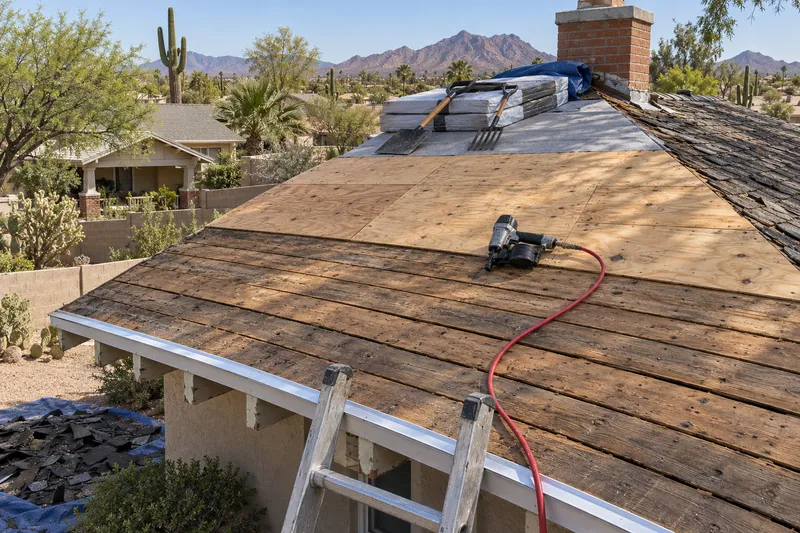
Illustrative bungalow roof during a shingle re-roof, old board sheathing exposed below new plywood, a nailer and air hose, shingle bundles at the ridge by the chimney
Illustration of the roofs described here, not a job of ours.

Bungalows in Catlin Court

William John Murphy’s Arizona Canal, finished in 1885, brought water to the land, and Glendale was platted in the 1890s. The Catlin Court historic district preserves early twentieth-century bungalows near downtown. Their pitched roofs are often on board sheathing that predates plywood, and a re-roof starts with checking that sheathing.
Postwar ranch houses

Central Glendale filled with postwar ranch houses on the grid between Grand Avenue and the canals. Many have low-pitched shingle roofs, some with flat sections over additions or carports. Those transitions between slopes need their own flashing and drainage assessment.

Newer west and north

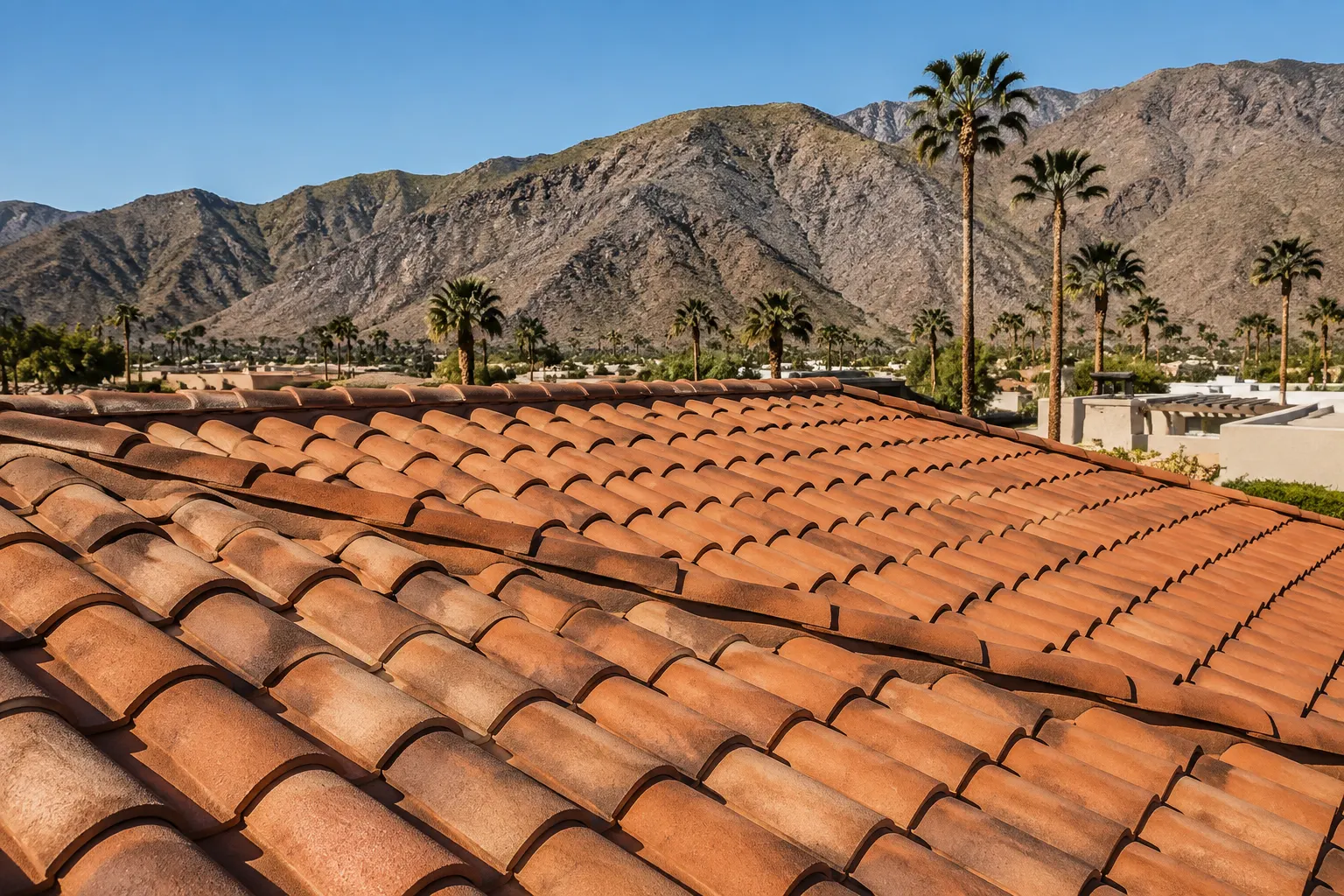
Arrowhead Ranch to the north and the sports and entertainment district to the west were built more recently, with concrete tile on houses and large low-slope roofs on commercial buildings. Different neighborhoods need different first questions.

Local building patterns help guide an inspection. Your roof’s actual condition, materials and repair history determine the recommendation.

Conditions

Roof exposure in Glendale.

  • Core-valley heat

    Glendale shares central Phoenix’s summer: long stretches above 100 °F and warm nights that never let roofs cool. Shingles lose granules and asphalt hardens. On older ranch houses, attic ventilation is part of the roof’s life.

  • Canals and irrigation

    The Arizona Canal and laterals still cross the city, and some older neighborhoods are flood irrigated. Keep roof runoff off stucco and foundations, especially where irrigation water already sits against the house.

  • Monsoon on old roofs

    Heavy storms find the weak spots on older roofs first: worn flashings at chimneys, low-slope sections over additions and patched valleys. A pre-season check is more useful than a post-storm one.

  • A code change in 2026

    Glendale adopted the 2024 International Codes in December 2025, effective January 9, 2026, with a grace period for some projects already in review. Confirm which edition governs a permit, then look up the site’s design wind speed.

Compare the same work

Before you approve a Glendale roofing estimate.

Use these points to make the proposed work specific to your property.

  • Identify board sheathing or other existing deck construction where accessible.
  • Show the connection between pitched roofing and flat additions in the scope.
  • For newer tile properties, document findings beneath the tile rather than assuming roof age.

Check the local approval route

Ask City of Glendale Building Safety which requirements apply to the parcel and proposed work. If another authority or an association also reviews the project, establish that before ordering materials.

City of Glendale Building Safety

Code and permits

Roofing codes and permits in Glendale.

Confirm the requirements for the building and proposed roof assembly. The links below go directly to the relevant authorities.

Glendale’s 2024 codes

Glendale adopted the 2024 International Codes and amendments on December 9, 2025, effective January 9, 2026, according to the city’s implementation memo. The 2018 codes remained available for certain projects already in development review until July 9, 2026. Confirm which edition applies to a permit.

Glendale’s building codes page

Climate zone 2B

Maricopa County is in IECC climate zone 2B, hot and dry. Arizona has no statewide energy code like California’s Title 24: the energy rules for a roof are the ones in the IECC edition the city has adopted, applied in that zone. Building type and roof slope still decide which of them apply to a given project.

The county climate zone guide

Wind

Maricopa County publishes no special wind region list, so there is no county figure to quote for Glendale; the design wind speed comes from the ASCE 7 maps for the individual site. Look the address up and confirm the figure with the building department. Wind load rises with the square of the speed, so a few miles an hour changes what the fastenings, the perimeter and the edge metal have to carry.

ATC Hazards by Location

Who issues the permit

City of Glendale Building Safety is the local authority for roofing permits. Establish the permit and inspection requirements for your project before work begins. Our Arizona license is ROC 367833.

City of Glendale Building Safety

Code editions and dates here are as each city published them. They explain what applies; they are not a site-specific design calculation. Confirm the governing edition and design criteria with the building department.

Before you plan the work

Roofing questions in Glendale.

What should be checked before reroofing an older Catlin Court home?

Assess the existing deck, layers and roof-edge details, and confirm any requirements applying to visible material changes on the property. The proposal should explain how deck suitability and concealed deterioration will be handled before the new assembly is installed.

Why inspect a flat carport roof separately from a Glendale home’s pitched roof?

It may have a different covering, slope and support history. The connection between the two roofs can require its own flashing detail. Ask the estimate to identify both sections and how water crosses or leaves their junction.

Does older board sheathing automatically need complete replacement?

No. Its condition and suitability for the proposed assembly need assessment. Ask what is known before removal and how any necessary repairs will be documented and approved. Age alone does not establish the required deck scope.

What matters on newer tile roofs in north and west Glendale?

Inspect the underlayment, wall connections, valleys and penetrations, along with tile condition. Establish previous repair work and whether damage is isolated. The appearance of the tile field does not establish the remaining condition of the hidden layers.

The whole service area, with Glendale marked. The pins are city centres. No job, photograph or date is marked on this map.

Directly northwest of Phoenix along Grand Avenue, about nine miles from downtown.

Elevation
1152 ft above sea level
Incorporated
1910
Population
248,325 2020 census
Area
65.09 sq mi
ZIP codes
85301–85312 and 85318
Energy code
IECC climate zone 2B

Elevation, incorporation, census and area are public record. The climate zone is Maricopa County's, from the county table in the International Energy Conservation Code.

Know what your
roof needs.

Free written estimate. No obligation.

California

(442) 637-5222

Arizona

(480) 978-5147

Coachella Valley + Greater Phoenix

A 50-mile Phoenix radius, including Buckeye.

Service hours

Mon–Fri
7:00 AM – 7:00 PM
Sat
8:00 AM – 5:00 PM
Sun
Closed

Add roof details (optional)

By requesting a quote, you agree that we may contact you about your roof. No obligation.