
Service area

Roofing in La Quinta.

The Cove’s tighter access and the rooflines of golf and resort communities need different plans. An estimate should account for delivery, drainage and material approval alongside the roof assembly.

The roofing decision

Plan the route onto the roof—and the water off it.

A La Quinta reroof is easier to compare when the practical details are written down. Where the property sits, how materials reach the roof and where outlets discharge can change the scope. In a managed community, the visible finish may also need review before the installation is scheduled.

Discuss your La Quinta roof
  1. Make the Cove access plan part of the proposal

    Check driveway capacity, side access, material staging and the route for removed roofing at the actual lot. A compact site may require a different delivery and cleanup sequence. Identify those arrangements before comparing two quotes that otherwise name the same roof system.

    Explore roof replacement
  2. Inspect the valleys on complex tile rooflines

    On resort and golf-community homes, roof planes can meet at several hips, valleys and walls. The inspection should explain which junctions were assessed and whether underlayment work is local or broader. Confirm any architectural requirements for replacement tile and ridge details.

    Explore tile roofing
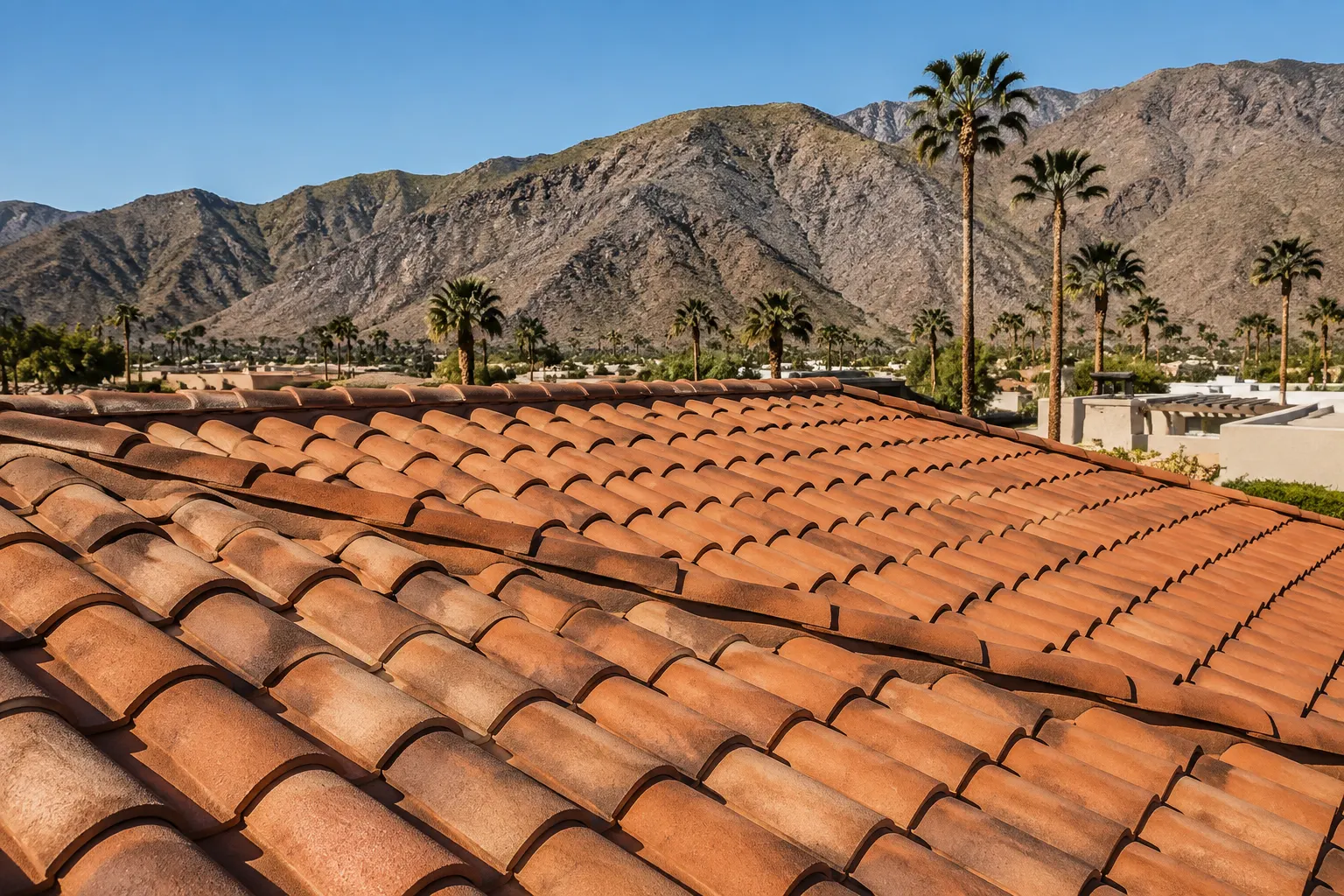
Illustrative view over the Cove, a tight grid of small homes pressed against the bare rock of the Santa Rosa Mountains
La Quinta, illustrated. Not a photograph of our work.

Conditions

Roof exposure in La Quinta.

  • Water off the mountains

    The Coachella Valley Water District describes flood-control dikes and levees near the valley’s cove communities. For an individual building, assess roof valleys, outlets and downspout discharge points as connected drainage routes. Mountain runoff and roof runoff are different issues, but both inform maintenance planning. Do not assume a roof repair alone will correct a site drainage problem.

  • Long-term sun exposure

    The local climate record includes summer highs above 108 °F and annual rain below 4 inches. Established homes may have years of heat and UV exposure across several roof assemblies or repair cycles. Inspect the current materials rather than assigning a remaining life from the construction date. Coating wear, flashing movement and underlayment condition help define the appropriate work.

  • Wind design depends on the site

    La Quinta is not among the communities named in the county’s July 2021 special wind region list, while nearby Santa Rosa and Vista Santa Rosa are included. The document states that the list is non-exhaustive. Confirm current criteria for the actual property during project planning. The relevant wind design informs tile fastening, perimeter details and the roof system specified for that site.

The roofs here

The roof assemblies behind La Quinta’s buildings.

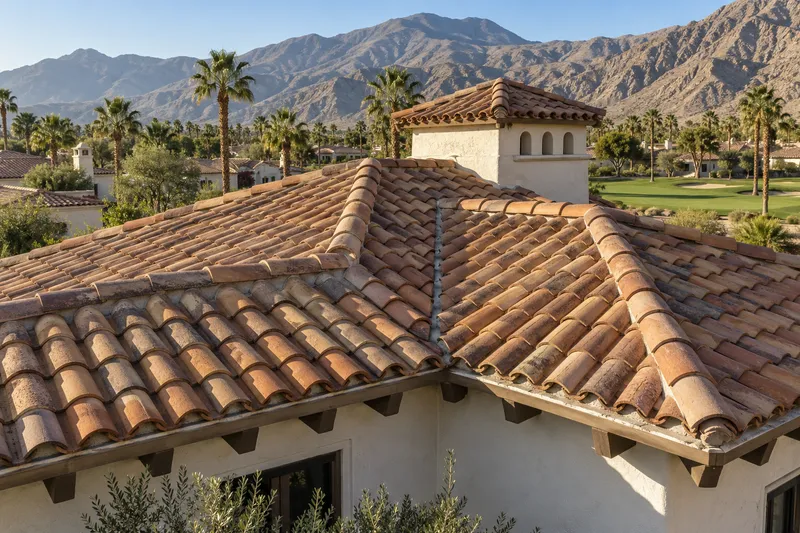
Illustrative terracotta barrel-tile roof where several hips and valleys meet, a small tower roof behind, a fairway and mountains beyond
Illustration of the roofs described here, not a job of ours.

Roof condition in established communities

La Quinta grew from 4,200 residents in 1980 to 37,467 in 2010, with a 2020 census population of 37,558. Much of its established housing dates to earlier periods of development. Roof history now matters as much as the age of the building. Assess original and replaced materials, previous repairs and the condition beneath the tile before deciding whether to repair or replace.
The Cove

The Cove’s streets sit close to the mountains, with many smaller lots and limited side access. Roof removal, material delivery and cleanup need a plan suited to the actual property. Establish where crews and materials can work without obstructing neighboring access. The location below steep terrain also makes roof outlets and the drainage routes below them important inspection points.

Resort and golf-course housing

The La Quinta Resort dates to 1926, while many golf-course communities developed later. Tile rooflines, hips and valleys are common features across these properties. An assessment should establish the underlayment and flashing condition, not just the visible tiles. Where an architectural committee governs appearance, confirm its requirements before specifying tile profiles, colors or other visible changes.

Local building patterns help guide an inspection. Your roof’s actual condition, materials and repair history determine the recommendation.

Compare the same work

Before you approve a La Quinta roofing estimate.

Use these points to make the proposed work specific to your property.

  • Show where deliveries, removal equipment and debris containers can be placed on the property.
  • Identify roof outlets and their discharge routes before proposing a coating or replacement.
  • Allow for architectural review where the community controls visible roof changes.

Check the local approval route

Ask City of La Quinta Building Division which requirements apply to the parcel and proposed work. If another authority or an association also reviews the project, establish that before ordering materials.

City of La Quinta Building Division

Code and permits

Roofing codes and permits in La Quinta.

Confirm the requirements for the building and proposed roof assembly. The links below go directly to the relevant authorities.

Climate zone 15

92253 falls in California building climate zone 15. Climate zone, building type and roof slope help determine the energy requirements for a proposed roof. California’s climate-zone rules do not apply to our Arizona service region.

The CEC's climate zone list

Cool roof requirements

California’s 2025 Energy Code took effect January 1, 2026. Cool-roof requirements vary by building type, climate zone, roof slope and project scope. Check the applicable path and the product’s CRRC rating before choosing a roof surface.

A single reflectance or SRI threshold does not apply to every roof. Confirm the current requirements and any exceptions with the building department.

Title 24 at the Cool Roof Rating Council

Wind

La Quinta is not named on the county’s special wind region list, though neighbouring Santa Rosa and Vista Santa Rosa are and the list is explicitly not exhaustive. The county's July 2021 handout gives 100 mph for Risk Category II, Exposure C outside a special wind region and 130 mph inside one, and directs designers to ATC Hazards by Location for the individual site. Wind load rises with the square of the speed, so the difference between those two numbers is about 69 per cent more load, which is why it is worth establishing rather than assuming.

The county's design load handout (PDF)

The county wind handout cited here is revision 07/2021, based on the 2019 California Building Code and ASCE 7-16. Its figures explain the cited document; they are not a current site-specific design calculation. Confirm the governing code edition and design criteria with the building department.

Before you plan the work

Roofing questions in La Quinta.

What should a roofing estimate include for a home in La Quinta Cove?

Include property access, material delivery, removal routes and cleanup arrangements, along with the roof system. Ask how roof drainage and discharge will be assessed. The actual lot layout determines whether extra staging or a different work sequence is needed.

Why inspect more than the tiles on a La Quinta resort-community home?

Valleys, walls and penetrations connect different parts of the roof and can conceal deterioration beneath intact tile. Ask what those details show about the underlayment and flashings, and whether the proposal addresses each affected roof plane.

Does a location near the mountains change the roof drainage inspection?

It makes it useful to review both roof outlets and where they discharge on the lot. Roof leakage and ground runoff are different issues. An inspection should identify the roof-side defect rather than assuming all water damage has the same source.

What should be settled before ordering new tile in a La Quinta community?

Confirm the proposed profile, color and visible details with any applicable architectural committee, and establish city requirements for the work. A replacement allowance should also explain how matching pieces will be sourced if existing tiles are being reused.

The whole service area, with La Quinta marked. The pins are city centres. No job, photograph or date is marked on this map.

South valley, between Indian Wells and Indio, with the Cove tucked into the foot of the Santa Rosa Mountains.

Elevation
135 ft above sea level
Incorporated
May 1, 1982
Population
37,558 2020 census
Area
35.68 sq mi
ZIP code
92253
Energy code
California climate zone 15

Elevation, incorporation, census and area are public record. The climate zone is read from the California Energy Commission's own list of building climate zones by ZIP code.

Know what your
roof needs.

Free written estimate. No obligation.

California

(442) 637-5222

Arizona

(480) 978-5147

Coachella Valley + Greater Phoenix

A 50-mile Phoenix radius, including Buckeye.

Service hours

Mon–Fri
7:00 AM – 7:00 PM
Sat
8:00 AM – 5:00 PM
Sun
Closed

Add roof details (optional)

By requesting a quote, you agree that we may contact you about your roof. No obligation.