
Service area

Roofing in Chandler.

Tile neighborhoods, the older downtown core and commercial campuses need different roofing scopes. On a home, inspect beneath the tile; on a business, include the equipment and drainage routes.

The roofing decision

Compare the hidden tile work with the visible finish.

Two Chandler homes from the same building period may have very different roof histories. One may retain original materials while another has replacement underlayment or repairs around solar. Establish that history before choosing a scope, and distinguish material appearance from the condition of the water-shedding layers.

Discuss your Chandler roof
  1. Use findings rather than a replacement birthday

    Inspect underlayment and flashings at representative valleys, walls and penetrations. Age helps frame the questions but does not prove that a roof needs replacement. Ask how the findings support localized work, a tile relay or a broader new assembly.

    Explore tile roofing
  2. Include the operating building in a commercial plan

    For offices or campuses around the Price Road corridor, identify equipment-service routes and occupied areas. A commercial scope should account for moisture condition, curbs and outlets, with a clear boundary between roofing work and equipment work.

    Explore commercial roofing
Illustrative view along a concrete-lined irrigation canal between tile-roofed subdivisions, a saguaro by the path, a last green field and low mountains beyond
Chandler, illustrated. Not a photograph of our work.

The roofs here

The roof assemblies behind Chandler’s buildings.

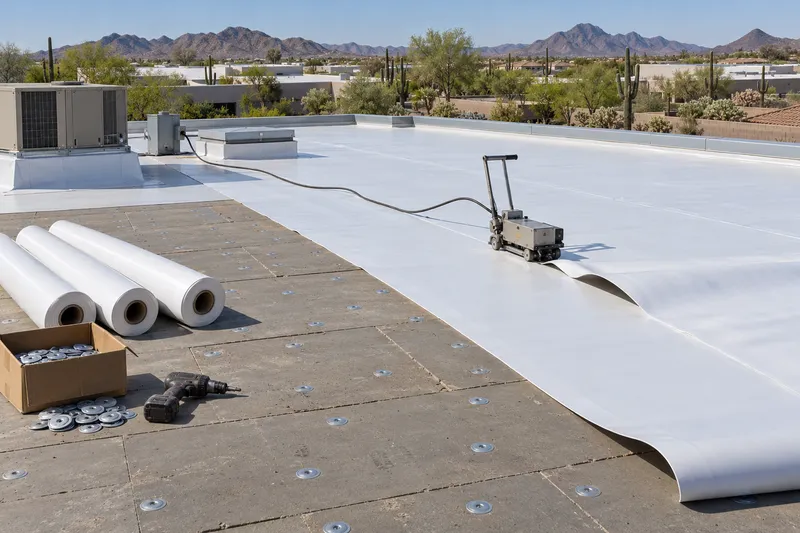
Illustrative flat campus roof during a single-ply re-roof, a hot-air welder on a seam of white membrane, insulation boards fastened with plates, rolls and a rooftop unit
Illustration of the roofs described here, not a job of ours.

The 1912 townsite

Dr. Alexander J. Chandler opened the townsite office in May 1912 on his ranch, with the Hotel San Marcos at its center. Downtown Chandler still has buildings from that era and the decades after, many with low-slope roofs and arcades. Older masonry buildings need parapets, wall flashings and drains inspected as closely as the roof surface.
Farmland to tile roofs

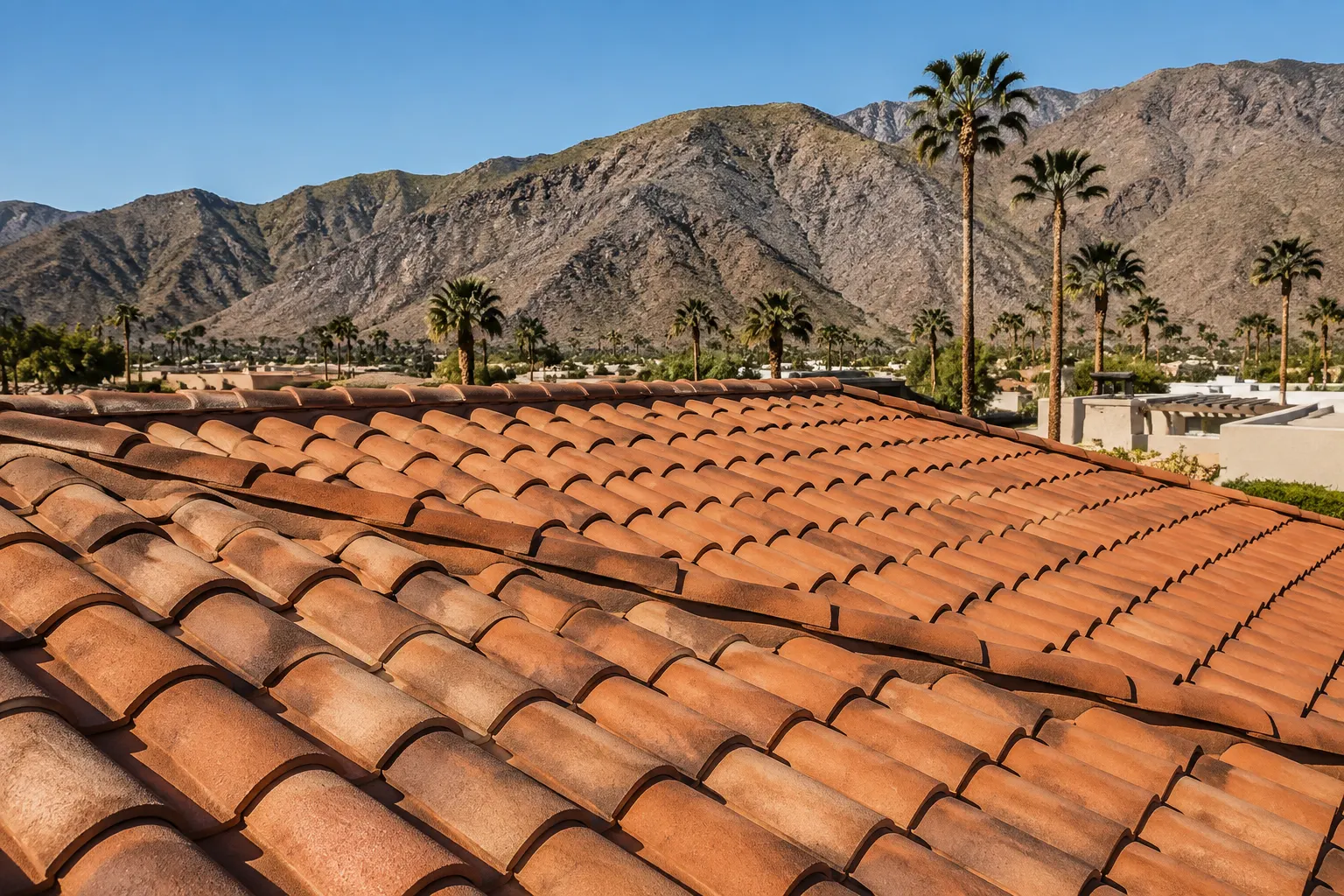
Chandler held only 3,800 people in 1950 and 30,000 by 1980; most of the city since then has been built on former farm fields. That means large neighborhoods of concrete tile roofs from the 1980s, 1990s and 2000s. Establish whether underlayment is original or replaced and assess its condition before choosing the next scope, even where the tile appears sound.

Campuses and industrial roofs

Manufacturing and technology campuses along the Price Road corridor brought large commercial roofs, and many smaller offices and shopping centers followed. These low-slope roofs are commonly foam, single-ply or built-up. Coatings and drainage set their maintenance schedule.

Local building patterns help guide an inspection. Your roof’s actual condition, materials and repair history determine the recommendation.

Conditions

Roof exposure in Chandler.

  • Southeast valley heat

    Chandler shares the long valley summer: weeks above 100 °F and intense UV. The underlayment under tile ages faster in that heat than in milder climates. On a thirty-year-old tile roof, plan for the underlayment rather than wait for the first leak.

  • Monsoon bursts on tile

    Short, heavy monsoon storms can drive water under cracked or slipped tile. Valleys, the area around chimneys and where roofs meet walls are the usual entry points. Look for broken tile and debris in the valleys before the season.

  • Irrigation, canals and soils

    Canals and irrigated lawns still run through the city, and some neighborhoods have flood irrigation. Water from irrigation and from roof runoff needs to stay away from foundations and stucco. Downspout extensions and grading do more good than people expect.

  • Plans submitted after mid-2025

    Chandler moved to the 2024 International Codes for plans submitted on or after July 1, 2025. A roof replacement may need to meet energy and roofing provisions of that edition. Confirm what the permit requires before the assembly is chosen.

Compare the same work

Before you approve a Chandler roofing estimate.

Use these points to make the proposed work specific to your property.

  • State what the inspection established about underlayment and previous roof work.
  • Separate tile reuse, flashing replacement and concealed deck repairs in the proposal.
  • Name the party coordinating rooftop equipment and business access on commercial properties.

Check the local approval route

Ask City of Chandler Building Safety which requirements apply to the parcel and proposed work. If another authority or an association also reviews the project, establish that before ordering materials.

City of Chandler Building Safety

Code and permits

Roofing codes and permits in Chandler.

Confirm the requirements for the building and proposed roof assembly. The links below go directly to the relevant authorities.

Chandler’s 2024 codes

Chandler has amended and adopted the 2024 editions of the International Codes with the 2023 National Electrical Code. All plans submitted for review on or after July 1, 2025, must comply with them. The city publishes its amendments to the 2024 codes alongside the adopted list.

Chandler Building Safety

Climate zone 2B

Maricopa County is in IECC climate zone 2B, hot and dry. Arizona has no statewide energy code like California’s Title 24: the energy rules for a roof are the ones in the IECC edition the city has adopted, applied in that zone. Building type and roof slope still decide which of them apply to a given project.

The county climate zone guide

Wind

Maricopa County publishes no special wind region list, so there is no county figure to quote for Chandler; the design wind speed comes from the ASCE 7 maps for the individual site. Look the address up and confirm the figure with the building department. Wind load rises with the square of the speed, so a few miles an hour changes what the fastenings, the perimeter and the edge metal have to carry.

ATC Hazards by Location

Who issues the permit

City of Chandler Building Safety is the local authority for roofing permits. Establish the permit and inspection requirements for your project before work begins. Our Arizona license is ROC 367833.

City of Chandler Building Safety

Code editions and dates here are as each city published them. They explain what applies; they are not a site-specific design calculation. Confirm the governing edition and design criteria with the building department.

Before you plan the work

Roofing questions in Chandler.

Does a Chandler home’s construction year tell me when to replace the roof?

It helps identify likely materials but does not establish their present condition. Prior reroofing, repairs and installation details matter. Inspect the actual underlayment, flashings and deck before using the construction date to justify replacement.

What should a Chandler tile relay estimate explain?

Explain the condition supporting tile reuse, removal and handling, replacement pieces, new underlayment and flashings. Ask how hidden deck damage will be documented and approved. A price for underlayment alone may omit important surrounding work.

What is different about an older downtown Chandler roof?

Earlier layers, parapets and masonry interfaces may need investigation before a new roof is specified. Assess the wall connection and outlets alongside the open surface. An estimate should identify which existing materials and details will remain.

What should a Chandler commercial roof plan say about equipment?

List relevant curbs and penetrations, access routes and any equipment that must be moved or disconnected by others. Identify the responsible party and sequencing. Roofing and equipment work need coordination before installation begins.

The whole service area, with Chandler marked. The pins are city centres. No job, photograph or date is marked on this map.

The southeast valley, about seventeen miles from downtown Phoenix, between Interstate 10 and the Loop 202.

Elevation
1211 ft above sea level
Incorporated
February 16, 1920
Population
275,987 2020 census
Area
65.55 sq mi
ZIP codes
85224–85226, 85244, 85246, 85248–85249 and 85286
Energy code
IECC climate zone 2B

Elevation, incorporation, census and area are public record. The climate zone is Maricopa County's, from the county table in the International Energy Conservation Code.

Know what your
roof needs.

Free written estimate. No obligation.

California

(442) 637-5222

Arizona

(480) 978-5147

Coachella Valley + Greater Phoenix

A 50-mile Phoenix radius, including Buckeye.

Service hours

Mon–Fri
7:00 AM – 7:00 PM
Sat
8:00 AM – 5:00 PM
Sun
Closed

Add roof details (optional)

By requesting a quote, you agree that we may contact you about your roof. No obligation.