
Service area

Roofing in Buckeye.

Verrado, Sundance and other newer neighborhoods sit alongside Buckeye’s older town properties. Inspect the actual assembly and affected details before using the age or appearance of the house to decide the scope.

The roofing decision

A younger tile roof still deserves a diagnosis.

A leak in a newer Buckeye subdivision can involve a specific flashing or damaged tile rather than widespread roof deterioration. An older property near the original townsite raises different questions about layers and deck condition. Both need evidence from the building instead of a replacement recommendation based on the neighborhood alone.

Discuss your Buckeye roof
  1. Separate a construction detail from broad deterioration

    On a younger tile roof, inspect the affected valley, wall or penetration and the surrounding underlayment. Ask whether the findings support localized work or a larger scope. Keep any builder or prior roof paperwork available so existing obligations can be checked separately.

    Explore tile roofing
  2. Establish what an older roof is carrying

    Near the older townsite, identify coverings, additions and accessible decking before pricing replacement. For an I-10 commercial property, add equipment curbs and moisture condition to that assessment before comparing foam or coating work.

    Explore roof replacement
Illustrative view over the last streets of a new tile-roofed community to open desert with saguaros, farm fields and the White Tank Mountains on the horizon
Buckeye, illustrated. Not a photograph of our work.

The roofs here

The roof assemblies behind Buckeye’s buildings.

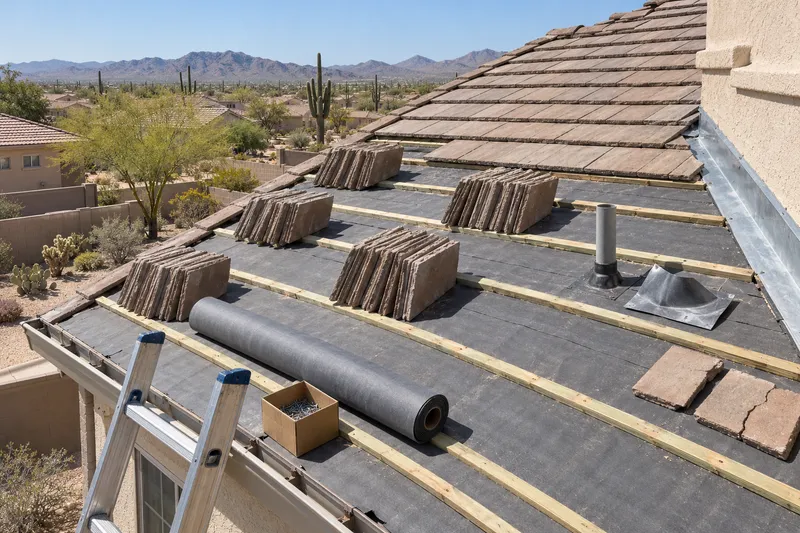
Illustrative concrete tile roof partway through an underlayment replacement, new battens over grey underlayment, removed tiles stood in rows, flashing along the wall
Illustration of the roofs described here, not a job of ours.

Master-planned roofs, early in their life

Buckeye grew from 50,876 residents in 2010 to 91,502 in 2020 and was the fastest-growing city in the United States in 2017, 2018 and 2021. Communities such as Verrado, Sundance and Festival Ranch hold much of that housing. On a young tile roof the useful inspection is about details: flashing at walls and penetrations, valleys, and tiles cracked by later trades walking on them.
The original farm town

Buckeye was founded in 1888 and named for the Buckeye Canal dug across the valley in the 1880s; it incorporated in 1929 with 440 acres. Houses and farm buildings near the original town site predate the subdivisions by decades and may carry low-slope, metal or several layers of older roofing. Establish what is actually on the deck before pricing a replacement.

Commercial roofs along Interstate 10

Interstate 10 runs through the middle of the city. Commercial and industrial buildings near it tend to have large low-slope roofs, where drainage, rooftop units and seams decide how the roof performs. A foam or coating proposal should begin with a moisture check of the existing assembly, because coating over wet material seals the problem in rather than solving it.

Local building patterns help guide an inspection. Your roof’s actual condition, materials and repair history determine the recommendation.

Conditions

Roof exposure in Buckeye.

  • Open western valley heat

    Buckeye sits at 1,076 feet in the open western end of the valley, with about 7.9 inches of rain a year in the 1971–2000 record. Long summers of heat and UV wear roofs the same way whether they are five years old or fifty: coatings chalk and thin, sealants harden, and flashings work loose. A young roof on an exposed south or west slope is not exempt.

  • Dust from open ground

    Between the subdivisions there is still open desert, farmland and active construction, and monsoon outflow can lift dust from all three. It collects in tile valleys, gutters and drains, and the gusts load ridge and edge tiles. After a storm season, check that drains run clear and that ridge and edge pieces are still fastened.

  • Short storms on fast ground

    The Gila River runs west through the Buckeye Valley south of the city center, and the White Tank Mountains rise inside the city’s northern limits. Monsoon rain arrives in short bursts on ground that sheds it quickly. On the roof, the question is whether gutters, downspouts and scuppers can carry a burst and discharge it away from the walls.

  • Establish the code and the wind speed

    Buckeye adopts and amends its own editions of the International Codes, and the design wind speed for a property comes from the ASCE 7 maps that code references. Neither is a number to borrow from a Phoenix project. Confirm the edition in force with Buckeye Building Safety and look up the site’s wind speed before choosing tile fastening and edge details.

Compare the same work

Before you approve a Buckeye roofing estimate.

Use these points to make the proposed work specific to your property.

  • Identify the specific defect and surrounding condition on a younger tile roof.
  • State known layers and how additional decking work will be approved after removal.
  • For low-slope commercial work, include substrate suitability and equipment-access arrangements.

Check the local approval route

Ask City of Buckeye Building Safety which requirements apply to the parcel and proposed work. If another authority or an association also reviews the project, establish that before ordering materials.

City of Buckeye Building Safety

Code and permits

Roofing codes and permits in Buckeye.

Confirm the requirements for the building and proposed roof assembly. The links below go directly to the relevant authorities.

Buckeye’s adopted code

Buckeye adopts the International Codes by ordinance, with its own local amendments, and the edition it enforces can change between code cycles. That edition sets the energy, roofing and structural rules for a permit. Confirm it with Buckeye Building Safety before the roof assembly is specified, especially for a project designed under an earlier cycle.

Buckeye Building Safety

Climate zone 2B

Maricopa County is in IECC climate zone 2B, hot and dry. Arizona has no statewide energy code like California’s Title 24: the energy rules for a roof are the ones in the IECC edition the city has adopted, applied in that zone. Building type and roof slope still decide which of them apply to a given project.

The county climate zone guide

Wind

Maricopa County publishes no special wind region list, so there is no county figure to quote for Buckeye; the design wind speed comes from the ASCE 7 maps for the individual site. Look the address up and confirm the figure with the building department. Wind load rises with the square of the speed, so a few miles an hour changes what the fastenings, the perimeter and the edge metal have to carry.

ATC Hazards by Location

Who issues the permit

City of Buckeye Building Safety is the local authority for roofing permits. Establish the permit and inspection requirements for your project before work begins. Our Arizona license is ROC 367833.

City of Buckeye Building Safety

Code editions and dates here are as each city published them. They explain what applies; they are not a site-specific design calculation. Confirm the governing edition and design criteria with the building department.

What we do

Roofing services in Buckeye.

Young tile roofs need detail work, older town-site buildings need their layers established, and commercial roofs need drainage and moisture checked before any coating.

Additional roofing services for homes and commercial properties:

Before you plan the work

Roofing questions in Buckeye.

Does a leaking tile roof in a newer Buckeye neighborhood need a full replacement?

A leak alone does not establish that. Inspect the affected detail and the surrounding assembly to distinguish a localized defect from widespread deterioration. Preserve builder and roofing records, but have actual roof findings guide the proposed work.

What should be checked on a roof near Buckeye’s original townsite?

Check existing layers, deck condition and any junctions to later additions. The visible covering may be newer than the building beneath it. Ask what removal and concealed-damage allowances are included before comparing replacement prices.

Should dust deposits change my Buckeye roof maintenance plan?

They are a reason to check outlets, tile valleys and low points for obstructed drainage. Dust does not by itself establish roof failure. Inspect the underlying materials and attachment details separately if damage or a recurring leak is also present.

What should an I-10 commercial roof coating proposal include?

Include the existing roof material, moisture assessment, preparation and treatment of drains and equipment curbs. Identify service access and business scheduling needs. The proposal should explain why the substrate is suitable for the selected coating system.

The whole service area, with Buckeye marked. The pins are city centres. No job, photograph or date is marked on this map.

West of Phoenix along Interstate 10, where the Buckeye Valley follows the Gila River below the White Tank Mountains.

Elevation
1076 ft above sea level
Incorporated
1929
Population
91,502 2020 census
Area
392.99 sq mi
ZIP codes
85326, 85396
Energy code
IECC climate zone 2B

Elevation, incorporation, census and area are public record. The climate zone is Maricopa County's, from the county table in the International Energy Conservation Code.

Know what your
roof needs.

Free written estimate. No obligation.

California

(442) 637-5222

Arizona

(480) 978-5147

Coachella Valley + Greater Phoenix

A 50-mile Phoenix radius, including Buckeye.

Service hours

Mon–Fri
7:00 AM – 7:00 PM
Sat
8:00 AM – 5:00 PM
Sun
Closed

Add roof details (optional)

By requesting a quote, you agree that we may contact you about your roof. No obligation.