
Service area

Roofing in Indian Wells.

For a seasonal home, a roof problem can remain unseen between visits. Inspection access, tile condition and community approvals deserve as much planning as the installation itself.

The roofing decision

Make the roof plan work while the house is closed.

Indian Wells homeowners may be managing roof work from another city while a property manager handles access. A useful plan identifies who can inspect the interior, share previous records and approve the work. The assembly still needs a condition-based assessment, whether the property has older tile or a recent replacement.

Discuss your Indian Wells roof
  1. Build a record between visits

    Ask the person looking after the home to document new staining and its discovery date. Supply previous roof invoices and known repair locations. Those records help an inspection focus on the affected areas without treating the age of the house as a diagnosis.

    Explore residential roofing
  2. Define retained tile and approved appearance

    If underlayment replacement is proposed, ask how tile condition and matching replacement pieces will be handled. Where an association reviews the work, confirm the profile, color and visible equipment or ridge changes before material is ordered.

    Explore tile roofing
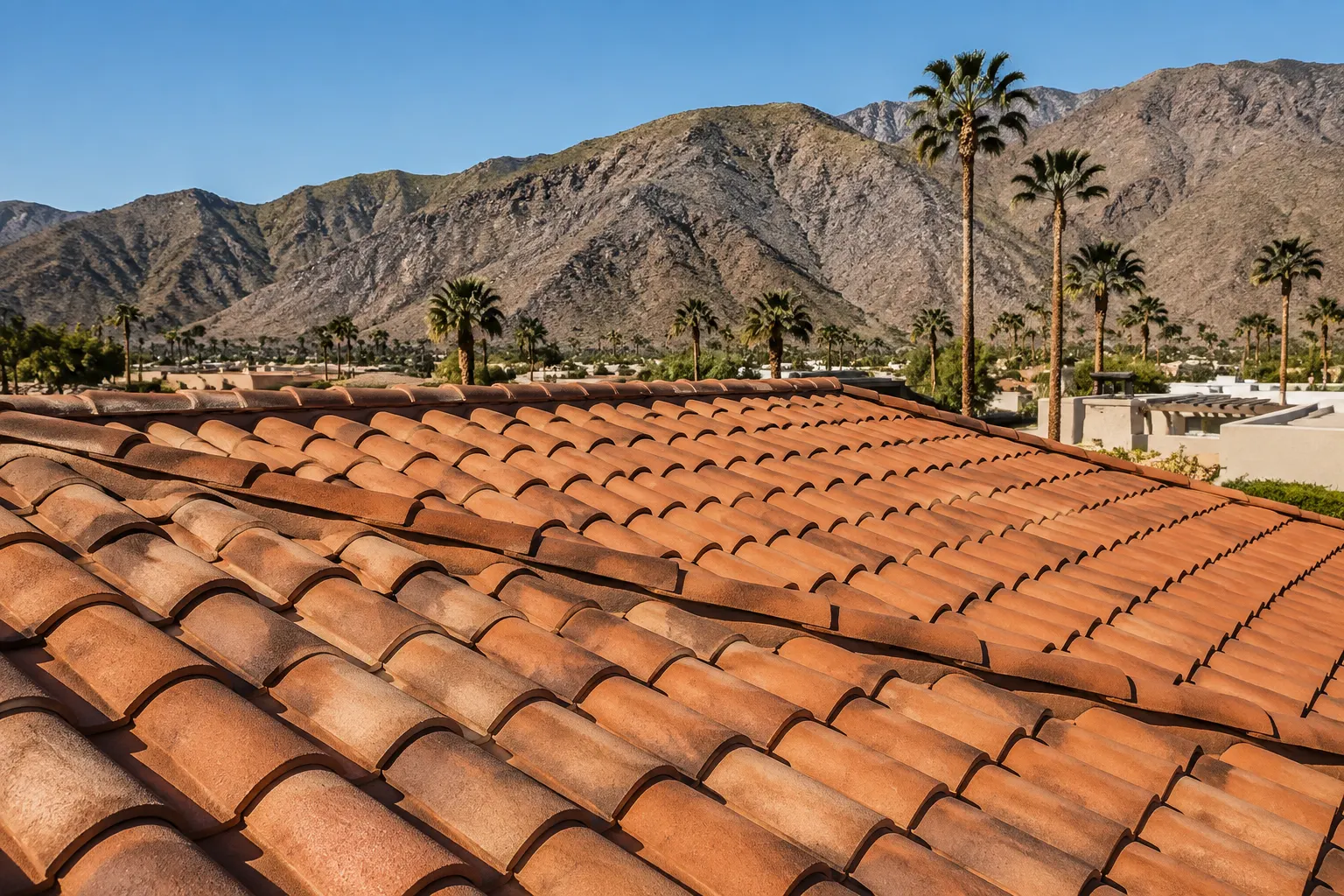
Illustrative view across a fairway with sprinklers running toward low tile-roofed homes with their sun shades lowered, the Santa Rosa Mountains behind
Indian Wells, illustrated. Not a photograph of our work.

The roofs here

The roof assemblies behind Indian Wells’s buildings.

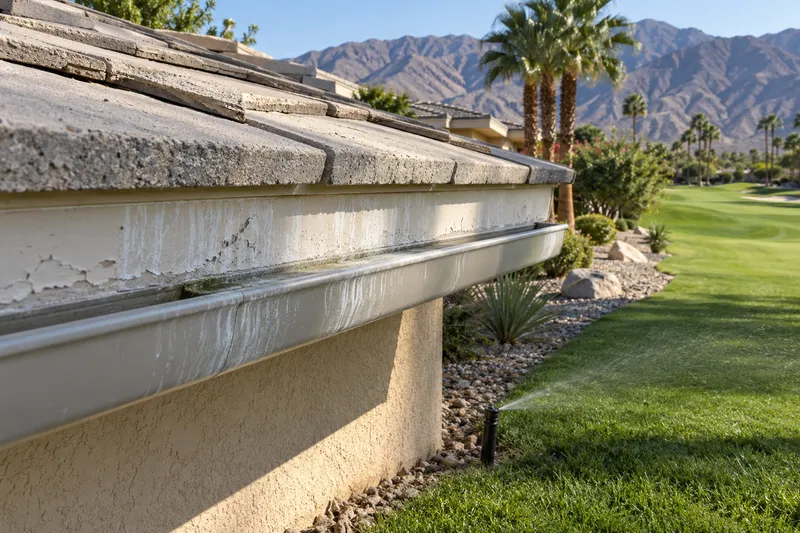
Illustrative close view of a tile roof eave, fascia and gutter streaked with white mineral deposits, a sprinkler spraying on the fairway beside it
Illustration of the roofs described here, not a job of ours.

Golf communities since the 1950s

The first golf courses in Indian Wells opened in the 1950s at Eldorado Country Club and Indian Wells Country Club, and resort hotels and gated communities followed after the city incorporated in 1967. Roofs there now range from decades-old tile to recent replacements. Establish the age and condition of the underlayment, not just the tile, before deciding on the next step.
Homes that are empty for months

The 2020 census counted 5,140 housing units in Indian Wells, and 48.8 percent of them were vacant. A leak that starts while a house is closed can run for months before anyone sees it. Arrange inspection access with the property manager or a neighbor, and check ceilings and roof details at the start and end of each season.

Association rules on the visible roof

Much of the housing in Indian Wells is in golf and resort communities, many with architectural committees. Tile profile, color, ridge treatment and rooftop equipment can all need approval in addition to a city permit. Confirm the committee’s requirements and submission timeline first, so the written proposal names a system the association has already accepted.

Local building patterns help guide an inspection. Your roof’s actual condition, materials and repair history determine the recommendation.

Conditions

Roof exposure in Indian Wells.

  • Wind design depends on the site

    Indian Wells is not among the communities named in the county’s July 2021 special wind region list, although Palm Desert on one side is. The handout says plainly that its list is not exhaustive. Confirm the current wind criteria for the actual address before choosing tile fastening and edge details, rather than assuming either the higher or the lower figure applies.

  • Sun on tile and underlayment

    Indian Wells lies under the same subtropical high that keeps the rest of the valley dry and clear for most of the year. Concrete and clay tile tolerate that sun well; the underlayment beneath them is what ages. Inspect it where tiles can be lifted, especially at valleys and walls, because intact tile on top says little about the layer that keeps the water out.

  • Fairways, irrigation and roof edges

    Homes in golf communities sit beside irrigated turf and sprinkler systems that run through the dry season. Overspray and mineral deposits can stain and wear the lower courses of tile, fascia and gutters. Check eaves and lower edges for staining or deterioration, and look at whether sprinkler heads near the house wet the roof edge or the walls.

Compare the same work

Before you approve a Indian Wells roofing estimate.

Use these points to make the proposed work specific to your property.

  • Name the owner representative who can provide interior access and approve additional work.
  • Include photos or a description of the roof details responsible for the proposed scope.
  • State tile reuse, replacement-piece sourcing and any community approval steps.

Check the local approval route

Ask City of Indian Wells Community Development, Building Division which requirements apply to the parcel and proposed work. If another authority or an association also reviews the project, establish that before ordering materials.

City of Indian Wells Community Development, Building Division

Code and permits

Roofing codes and permits in Indian Wells.

Confirm the requirements for the building and proposed roof assembly. The links below go directly to the relevant authorities.

Climate zone 15

92210 falls in California building climate zone 15. Climate zone, building type and roof slope help determine the energy requirements for a proposed roof. California’s climate-zone rules do not apply to our Arizona service region.

The CEC's climate zone list

Cool roof requirements

California’s 2025 Energy Code took effect January 1, 2026. Cool-roof requirements vary by building type, climate zone, roof slope and project scope. Check the applicable path and the product’s CRRC rating before choosing a roof surface.

A single reflectance or SRI threshold does not apply to every roof. Confirm the current requirements and any exceptions with the building department.

Title 24 at the Cool Roof Rating Council

Wind

Indian Wells is not named on the county’s special wind region list, though neighbouring Palm Desert is and the list is explicitly not exhaustive. The county's July 2021 handout gives 100 mph for Risk Category II, Exposure C outside a special wind region and 130 mph inside one, and directs designers to ATC Hazards by Location for the individual site. Wind load rises with the square of the speed, so the difference between those two numbers is about 69 per cent more load, which is why it is worth establishing rather than assuming.

The county's design load handout (PDF)

The county wind handout cited here is revision 07/2021, based on the 2019 California Building Code and ASCE 7-16. Its figures explain the cited document; they are not a current site-specific design calculation. Confirm the governing code edition and design criteria with the building department.

Before you plan the work

Roofing questions in Indian Wells.

What should I do about a roof stain found when reopening an Indian Wells home?

Photograph the stain and record when it was found, then arrange an inspection of the affected roof area and water path. The date you discover staining is not necessarily the date water entered. Share prior repair records and any caretaker observations.

What should my property manager have for a roofing estimate?

Provide access arrangements, owner authorization, known leak locations and previous roofing paperwork. Agree who receives the estimate and who can approve concealed damage discovered later. That avoids making material and scope decisions through incomplete messages.

How should tile reuse be described for an Indian Wells reroof?

The proposal should explain which tiles are candidates for reuse, handling and storage, replacement pieces and the flashing work beneath them. Any association requirements for profile or color should be resolved before the installation is scheduled.

What roof details deserve attention before a seasonal absence?

Ask for an assessment of accessible outlets, valleys, penetrations and previous repairs, and arrange a way to report changes while the home is closed. The inspection findings and existing roof system should determine the maintenance plan.

The whole service area, with Indian Wells marked. The pins are city centres. No job, photograph or date is marked on this map.

Mid-valley, between Palm Desert and La Quinta, on the fan below the Santa Rosa Mountains.

Elevation
89 ft above sea level
Incorporated
July 14, 1967
Population
4,757 2020 census
Area
14.58 sq mi
ZIP code
92210
Energy code
California climate zone 15

Elevation, incorporation, census and area are public record. The climate zone is read from the California Energy Commission's own list of building climate zones by ZIP code.

Know what your
roof needs.

Free written estimate. No obligation.

California

(442) 637-5222

Arizona

(480) 978-5147

Coachella Valley + Greater Phoenix

A 50-mile Phoenix radius, including Buckeye.

Service hours

Mon–Fri
7:00 AM – 7:00 PM
Sat
8:00 AM – 5:00 PM
Sun
Closed

Add roof details (optional)

By requesting a quote, you agree that we may contact you about your roof. No obligation.