
Service area

Roofing in Surprise.

Phased tile communities and the older original townsite need different roof plans. Inspect the current assembly and settle visible material choices before any community review or ordering.

The roofing decision

Confirm the material plan before the community submission.

A Surprise community built in phases can have different roof ages and repair histories within the same development. The useful question is what is installed on your house now. If an association controls appearance, the estimate also needs a defined tile profile, color and replacement-piece plan.

Discuss your Surprise roof
  1. Inspect the roof rather than its development phase

    Ask what the underlayment, pipe flashings and valley details show on the actual property. Identify prior repairs or relays where known. A similar house being reroofed nearby is a prompt for assessment, not proof that every roof needs replacement.

    Explore tile roofing
  2. Align reuse with community appearance requirements

    If tile is retained, establish suitable pieces, handling and replacements before the submission. Confirm any applicable profile and color rules. Older townsite homes may instead need investigation of layered shingle or low-slope assemblies and connections to additions.

    Explore roof replacement
Illustrative view along a curving street of low tile-roofed homes with desert landscaping and saguaros, the White Tank Mountains faint on the horizon
Surprise, illustrated. Not a photograph of our work.

The roofs here

The roof assemblies behind Surprise’s buildings.

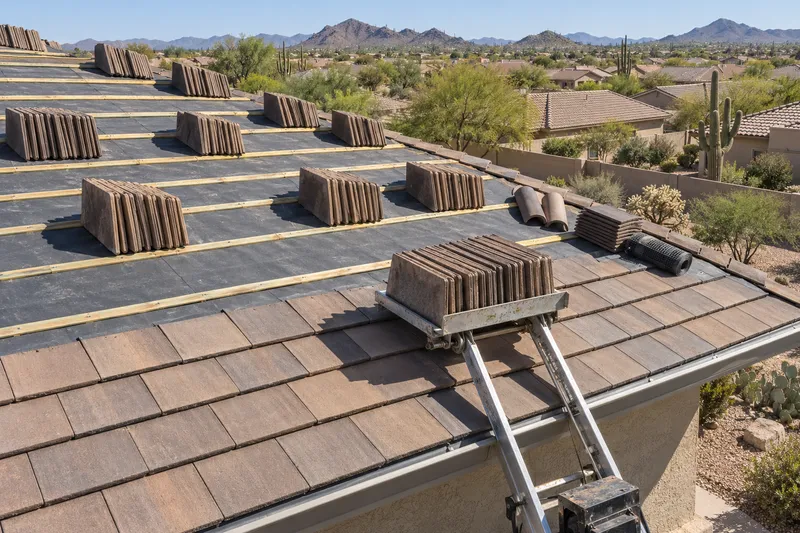
Illustrative tile re-roof in progress, finished courses at the eave, new tile in leaning rows on battens above, a ladder hoist at the eave loaded with tile
Illustration of the roofs described here, not a job of ours.

The original square mile

Flora Mae Statler founded Surprise in 1938 on a one-square-mile parcel subdivided for inexpensive houses for farm workers; the original townsite is bounded by Greenway, El Mirage, Bell and Dysart roads. Houses there are older and smaller, often with low-slope or shingle roofs and several re-roofs. Check the layers and deck first.
Active-adult communities

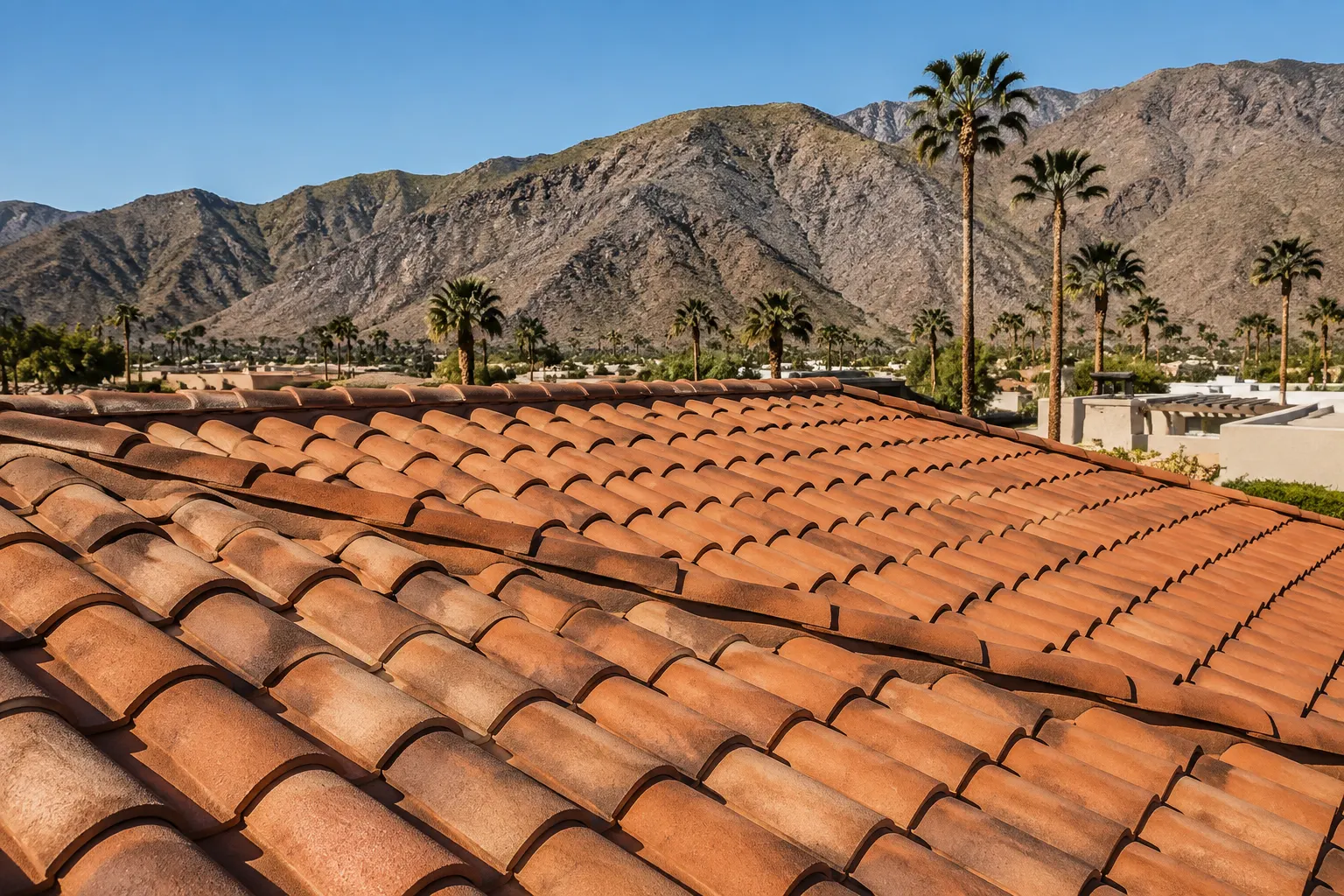
Sun City Grand and other active-adult communities hold a large share of the city’s houses. They were built in phases from the 1990s on, with concrete tile on most. Assess the actual underlayment and roof history on each property; HOA rules may also control tile color and profile.

Growth from 2000 on

Surprise grew from 30,848 people in 2000 to 143,148 in 2020. Most of its houses were built during that growth, with tile and shingle roofs now fifteen to twenty-five years old. Flashings, pipe boots and valley metal are where these roofs start to leak.

Local building patterns help guide an inspection. Your roof’s actual condition, materials and repair history determine the recommendation.

Conditions

Roof exposure in Surprise.

  • Open northwest valley sun

    Surprise sits on the broad, open northwest valley floor with little shade. Summer heat and sun dry out underlayment and age shingles fast. West-facing slopes show it first.

  • Dust from open land

    Farmland, open desert and active building sites remain around the city. Monsoon outflow drives that dust into tile valleys, gutters and roof vents. A yearly clean-out keeps water moving.

  • Washes from the White Tanks

    The western part of the city reaches toward the White Tank Mountains, and washes carry storm runoff across it. Lots near washes need roof runoff directed away from the foundation and not into the wash.

  • 2024 codes from January 2026

    Surprise adopted the 2024 International Codes and the 2023 National Electrical Code, effective January 1, 2026, for new permit applications. Standard plans approved under the 2018 codes stay valid until January 1, 2027. Confirm the edition before specifying a roof.

Compare the same work

Before you approve a Surprise roofing estimate.

Use these points to make the proposed work specific to your property.

  • Document actual roof work and findings rather than assuming a development-wide replacement date.
  • Specify tile reuse, matching pieces and the appearance being submitted for review.
  • Identify layers and addition connections separately on older townsite properties.

Check the local approval route

Ask City of Surprise Community Development which requirements apply to the parcel and proposed work. If another authority or an association also reviews the project, establish that before ordering materials.

City of Surprise Community Development

Code and permits

Roofing codes and permits in Surprise.

Confirm the requirements for the building and proposed roof assembly. The links below go directly to the relevant authorities.

Surprise’s 2024 codes

Surprise adopted the 2024 International Codes and the 2023 National Electrical Code with local amendments, in effect for permit applications submitted on or after January 1, 2026. Projects already submitted, in review or under construction were not affected. Confirm the edition with Community Development.

Surprise permits and inspections

Climate zone 2B

Maricopa County is in IECC climate zone 2B, hot and dry. Arizona has no statewide energy code like California’s Title 24: the energy rules for a roof are the ones in the IECC edition the city has adopted, applied in that zone. Building type and roof slope still decide which of them apply to a given project.

The county climate zone guide

Wind

Maricopa County publishes no special wind region list, so there is no county figure to quote for Surprise; the design wind speed comes from the ASCE 7 maps for the individual site. Look the address up and confirm the figure with the building department. Wind load rises with the square of the speed, so a few miles an hour changes what the fastenings, the perimeter and the edge metal have to carry.

ATC Hazards by Location

Who issues the permit

City of Surprise Community Development is the local authority for roofing permits. Establish the permit and inspection requirements for your project before work begins. Our Arizona license is ROC 367833.

City of Surprise Community Development

Code editions and dates here are as each city published them. They explain what applies; they are not a site-specific design calculation. Confirm the governing edition and design criteria with the building department.

Before you plan the work

Roofing questions in Surprise.

Does a Surprise community’s construction phase establish roof replacement timing?

It provides background but does not establish current roof condition. Original materials, relays and repairs can differ between homes. Ask what inspection findings support the scope for your roof rather than using the development phase alone.

What should I submit to an association for a Surprise tile reroof?

Check the association’s actual requirements, then submit the defined profile, color and visible details it requests. If tile reuse is proposed, explain replacement pieces too. The material plan should be resolved before ordering or scheduling installation.

What should be checked on a roof in Surprise’s original townsite?

Identify the roof layers, accessible decking and connections to later additions. Older shingle and low-slope roofs can have different scopes from tile subdivisions. Ask how removal and concealed repairs will be handled.

What should be inspected after gusts affect a Surprise tile roof?

Assess ridges, edges, displaced or broken pieces and the details beneath affected areas when appropriate. Visible damage should be documented, but it does not establish the entire roof’s condition. Use the actual findings to define the work.

The whole service area, with Surprise marked. The pins are city centres. No job, photograph or date is marked on this map.

The far northwest valley along Grand Avenue and Bell Road, west of Sun City and El Mirage.

Elevation
1385 ft above sea level
Incorporated
December 12, 1960
Population
143,148 2020 census
Area
110.52 sq mi
ZIP codes
85374, 85378–85379 and 85387–85388
Energy code
IECC climate zone 2B

Elevation, incorporation, census and area are public record. The climate zone is Maricopa County's, from the county table in the International Energy Conservation Code.

Know what your
roof needs.

Free written estimate. No obligation.

California

(442) 637-5222

Arizona

(480) 978-5147

Coachella Valley + Greater Phoenix

A 50-mile Phoenix radius, including Buckeye.

Service hours

Mon–Fri
7:00 AM – 7:00 PM
Sat
8:00 AM – 5:00 PM
Sun
Closed

Add roof details (optional)

By requesting a quote, you agree that we may contact you about your roof. No obligation.