
Service area

Roofing in Desert Hot Springs.

Exposed residential roofs and older low-slope spa buildings need different inspections. Look at attachment and edges, the condition beneath the covering and any moisture before choosing the next roof system.

The roofing decision

Specify the attachment, not just the covering.

A Desert Hot Springs estimate should explain how the assembly connects to the building as well as what covers it. On tile housing, that means the hidden layers and attachment details. On an older spa or motel roof, equipment penetrations and the moisture condition of the existing assembly are central to a coating decision.

Discuss your Desert Hot Springs roof
  1. Define edges and fastening in a replacement

    Use current property-specific design criteria when specifying attachment, edge metal and perimeter details. A regional wind description is background, not an installation schedule. The estimate should also establish how many existing layers will be removed and how deck condition will be handled.

    Explore roof replacement
  2. Check the substrate before coating a spa roof

    Low-slope motel and spa roofs may have older patches and multiple equipment penetrations. Establish moisture condition and compatibility before proposing SPF work or a recoat. Identify which curbs, wall connections and outlets will be repaired as part of the preparation.

    Explore spf recoating
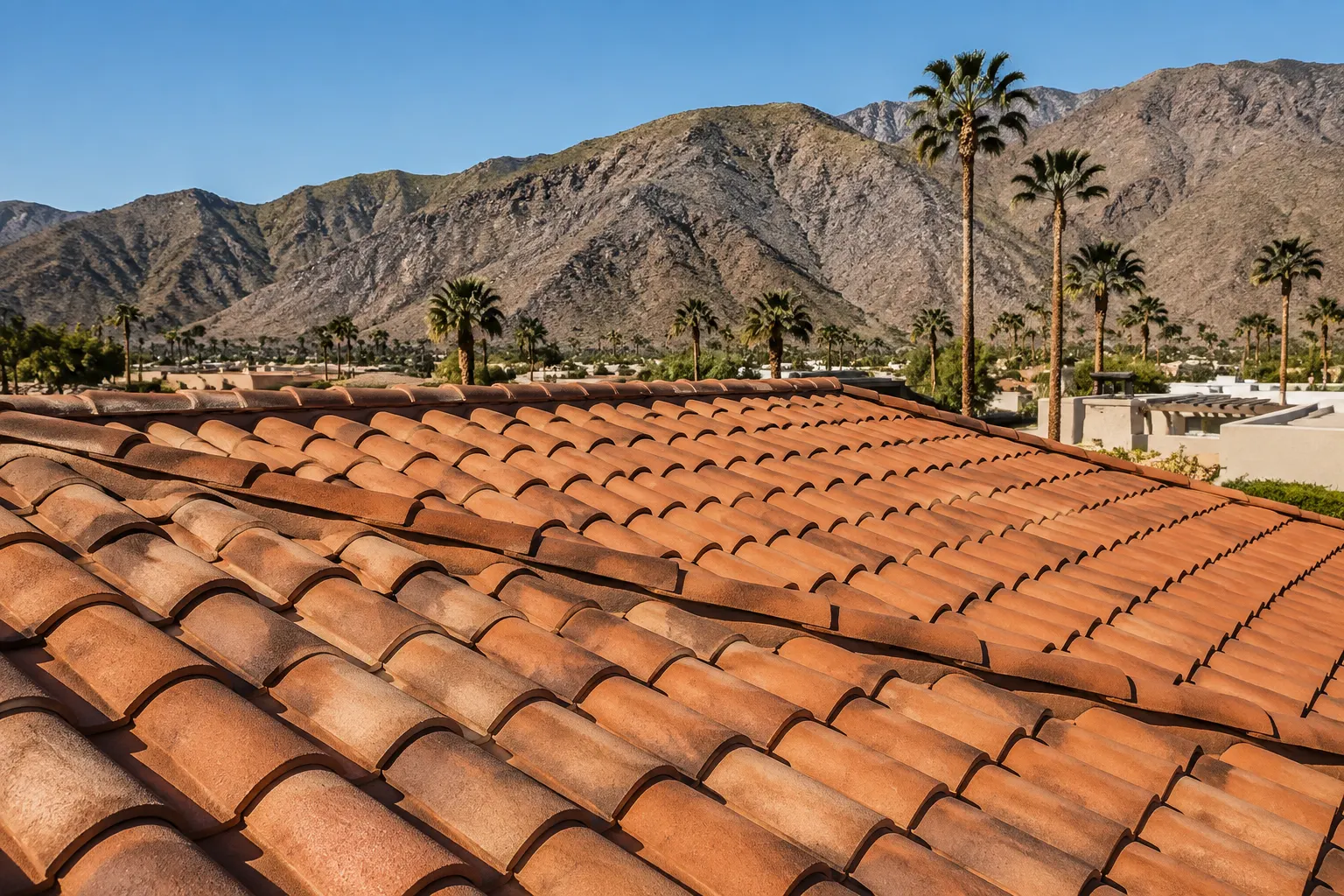
Illustrative view from the hillside over homes with tile and flat roofs, the valley spread out below and Mount San Jacinto across it
Desert Hot Springs, illustrated. Not a photograph of our work.

Conditions

Roof exposure in Desert Hot Springs.

  • A special wind region, on the county’s own list

    Riverside County Building & Safety names Desert Hot Springs in the special wind region list in its July 2021 handout, alongside nearby Sky Valley, Desert Edge and North Palm Springs. That document cites 130 mph for Risk Categories I and II at Exposure C, against 100 mph outside the region. Confirm current site criteria before specifying fastening, edge metal or tile attachment.

  • Above the county’s thousand-foot line

    The city’s recorded elevation is 1,076 feet. The county’s handout notes that where a site is above 1,000 feet, a site-specific study may be required to establish the ground snow load. That matters most for new construction or a structural change, where the designer should check it rather than borrow a figure from a valley-floor project.

  • Heat and the daily swing

    Summer days frequently exceed 107 °F, and the city gets less than six inches of rain a year. Heat waves above 110 °F are not unusual. Repeated heating and cooling moves roof materials and works sealants and flashings loose, so inspect laps, penetrations and edge metal along with the open roof, and look at where earlier repairs meet the original covering.

The roofs here

The roof assemblies behind Desert Hot Springs’s buildings.

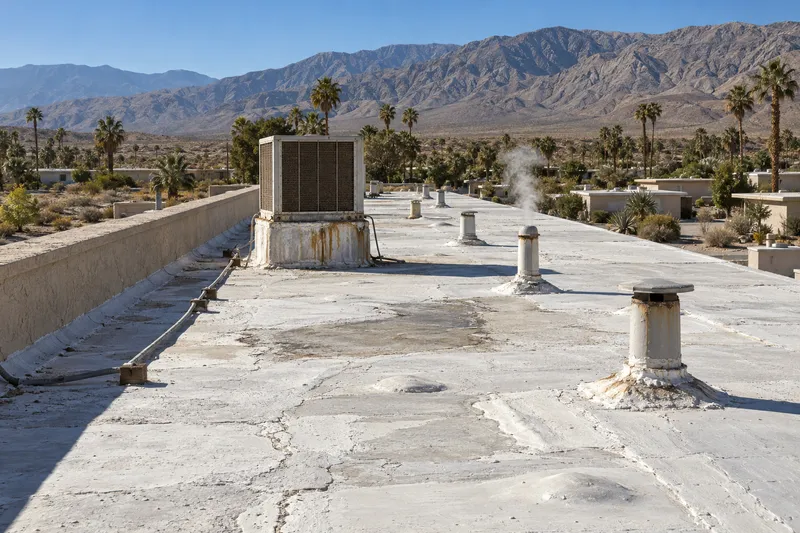
Illustrative view along an old white-coated flat roof with blisters and a ponding stain, an evaporative cooler and a vent releasing a wisp of steam
Illustration of the roofs described here, not a job of ours.

Houses from the 1980s and 1990s

Desert Hot Springs had about 2,700 residents in the 1970s; the population doubled in the 1980s, when most of the vacant lots filled with houses and duplexes, and reached 32,512 in 2020. Those buildings can have original components, later coverings or multiple repairs. Establish how many layers are on the deck before pricing a replacement.
Mid-century spa motels

The town had more than eighty small spa hotels in the 1950s and 1960s, and many of the survivors are mid-century buildings, some with flat or low-slope roofs. Mineral-water pools, steam and rooftop equipment add penetrations and moisture to an older assembly. A coating or foam proposal should start with a moisture check, so wet material is not sealed in under a new surface.

Rental housing

The 2020 census found just over half of the city’s occupied homes were rented. On a rental property the owner may not live nearby and the tenant may not report a slow leak. Agree in advance who gives access and who approves the work, and get the written scope to the owner, so the repair is authorized before the next storm.

Local building patterns help guide an inspection. Your roof’s actual condition, materials and repair history determine the recommendation.

Compare the same work

Before you approve a Desert Hot Springs roofing estimate.

Use these points to make the proposed work specific to your property.

  • State the proposed assembly and the process for establishing current attachment requirements.
  • Identify moisture investigation and preparation before any low-slope coating work.
  • For rentals, name the owner approving the scope and the contact arranging tenant access.

Check the local approval route

Ask City of Desert Hot Springs Building Division which requirements apply to the parcel and proposed work. If another authority or an association also reviews the project, establish that before ordering materials.

City of Desert Hot Springs Building Division

Code and permits

Roofing codes and permits in Desert Hot Springs.

Confirm the requirements for the building and proposed roof assembly. The links below go directly to the relevant authorities.

Climate zone 15

Both 92240 and 92241 fall in California building climate zone 15. Climate zone, building type and roof slope help determine the energy requirements for a proposed roof. California’s climate-zone rules do not apply to our Arizona service region.

The CEC's climate zone list

Cool roof requirements

California’s 2025 Energy Code took effect January 1, 2026. Cool-roof requirements vary by building type, climate zone, roof slope and project scope. Check the applicable path and the product’s CRRC rating before choosing a roof surface.

A single reflectance or SRI threshold does not apply to every roof. Confirm the current requirements and any exceptions with the building department.

Title 24 at the Cool Roof Rating Council

Wind

Riverside County Building & Safety names Desert Hot Springs among the communities lying inside an ASCE 7 special wind region in its July 2021 handout. That document puts the gust there at 130 mph for Risk Category II, Exposure C, against 100 mph in the parts of the county that are not. Wind load rises with the square of the speed, so that is about 69 per cent more load — carried by the fastenings, the perimeter and the edge metal.

The county's design load handout (PDF)

The county wind handout cited here is revision 07/2021, based on the 2019 California Building Code and ASCE 7-16. Its figures explain the cited document; they are not a current site-specific design calculation. Confirm the governing code edition and design criteria with the building department.

What we do

Roofing services in Desert Hot Springs.

Houses from the growth years need their layers and deck established; older spa and commercial buildings need moisture and drainage checked before any coating.

Additional roofing services for homes and commercial properties:

Before you plan the work

Roofing questions in Desert Hot Springs.

What should a Desert Hot Springs reroof proposal say about wind?

It should identify the attachment and perimeter details required for the specific property and proposed system. The county’s older regional handout provides context, but current governing criteria need confirmation before specifying fastenings or tile attachment.

Can an older spa or motel roof simply receive another coating?

Only after the existing roof is assessed for suitability. Check moisture, prior coatings, drainage and equipment connections. Wet or deteriorated areas and defective flashings need a defined scope; a new coating alone does not resolve every underlying problem.

Why identify existing roof layers before replacing a Desert Hot Springs roof?

The layers affect removal, preparation and the view of the deck beneath. A quote should say what is known and how concealed deterioration will be documented if tear-off reveals more work, rather than assuming the visible roof tells the whole history.

What helps arrange roof work on a Desert Hot Springs rental?

Identify the owner or authorized manager, the tenant access contact and known interior leak locations. Put the proposed work and the process for approving additional findings in writing. Tenant access and owner authorization are separate arrangements.

The whole service area, with Desert Hot Springs marked. The pins are city centres. No job, photograph or date is marked on this map.

North valley, above Interstate 10, on the slopes rising toward Joshua Tree.

Elevation
1076 ft above sea level
Incorporated
September 25, 1963
Population
32,512 2020 census
Area
30.66 sq mi
ZIP codes
92240, 92241
Energy code
California climate zone 15

Elevation, incorporation, census and area are public record. The climate zone is read from the California Energy Commission's own list of building climate zones by ZIP code.

Know what your
roof needs.

Free written estimate. No obligation.

California

(442) 637-5222

Arizona

(480) 978-5147

Coachella Valley + Greater Phoenix

A 50-mile Phoenix radius, including Buckeye.

Service hours

Mon–Fri
7:00 AM – 7:00 PM
Sat
8:00 AM – 5:00 PM
Sun
Closed

Add roof details (optional)

By requesting a quote, you agree that we may contact you about your roof. No obligation.